
The Research Platform Built for Serious Investors
Over the years I have noticed something about the investing world. Most investors spend their time chasing the wrong things. They look for the next hot stock, the next market prediction, or the next headline that might explain what the market will do tomorrow.
But the investors who tend to do best over time usually approach things very differently. They spend more time trying to understand what they actually own and why they own it.
That takes research. Real research, not just a quick glance at a price chart.
One of the platforms that has helped investors do that for decades is Morningstar. It has been around a long time, and many professional advisors and portfolio managers still rely on it for evaluating funds, stocks, and entire portfolios.
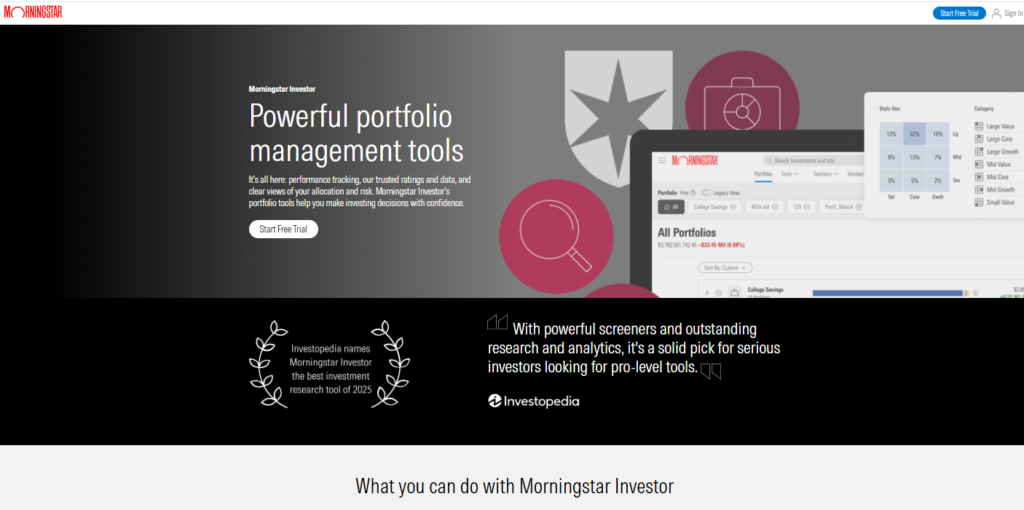
What has always appealed to me about Morningstar is its emphasis on long-term analysis. It is not built around trading ideas or daily market noise. It is built around understanding investments.
I should also mention that I have not used every feature Morningstar offers. The platform is extensive and contains a tremendous amount of data. But I have spent enough time with it over the years to appreciate the depth of research it provides and the perspective it offers long-term investors.
What Morningstar Is Known For
Morningstar originally built its reputation analyzing mutual funds.
Its well-known star rating system became a simple way for investors to compare thousands of funds. Over time, however, the platform grew into something much broader.
Today Morningstar provides tools for analyzing:
• Mutual funds and ETFs
• Individual stocks
• Portfolio allocations
• Long-term performance history
What I have always appreciated about Morningstar is the emphasis on fundamentals and long-term performance, rather than predictions about what the market might do next. You learn a lot just by using the program.
Key Features Investors Use Most
Fund and ETF research
Morningstar’s database of funds and ETFs is one of the largest available to individual investors.
You can review long-term performance, expense ratios, portfolio holdings, sector exposure, and risk metrics. For anyone who invests through mutual funds or ETFs, this information can be extremely useful.
Many investors discover they were not nearly as diversified as they thought once they begin looking at the underlying holdings of their funds.
Stock research reports
Morningstar also produces research reports on individual companies.
These reports often include analyst estimates of fair value, competitive advantages (what Morningstar calls an “economic moat”), financial strength, and long-term growth prospects.
Even if you do not rely on analyst ratings, the research itself can provide helpful context when evaluating a company.
Portfolio analysis tools
Another useful feature is Morningstar’s portfolio analysis tools.
By entering your holdings, you can see how your entire portfolio is allocated across sectors, asset classes, and geographic regions. It can quickly highlight areas where your portfolio might be more concentrated than you realized.
This kind of analysis can be helpful when reviewing whether your portfolio still matches your long-term strategy.
Long-term performance data
Morningstar’s historical performance data is one of its biggest strengths.
Instead of focusing on short-term price charts, you can see how funds and investments performed across many different market environments. For long-term investors, that perspective is often far more useful than watching daily price movements.
Who Morningstar Is Best For
Morningstar is not designed for day traders.
It works best for investors who want to:
• evaluate funds and ETFs carefully
• research companies before investing
• understand how their portfolio is actually diversified
• focus on long-term performance rather than short-term price moves
If your approach to investing is built around patience and research rather than speculation, Morningstar can be a very useful resource.
Strengths of Morningstar
Morningstar’s biggest strength is the depth of its research.
The platform provides access to decades of historical data and detailed analysis across thousands of investments. That kind of perspective can help investors make more informed decisions.
Another advantage is the focus on fundamentals rather than hype. Many modern investing platforms are designed to keep users trading frequently. Morningstar tends to encourage the opposite: thoughtful evaluation and longer time horizons.
Limitations to Be Aware Of
Morningstar is not the flashiest platform on the internet.
Because it contains so much information, the interface can take a little time to learn. Some investors may also find that the premium subscription is more than they need if they only check research occasionally.
Still, even the basic research available through Morningstar can be valuable when evaluating investments.
Why Morningstar Fits the Smart Personal Finance Philosophy
On this site we emphasize a few simple principles when evaluating investment tools.
Think long term.
Focus on process instead of predictions.
Evaluate data rather than chasing speculation.
Morningstar aligns well with those ideas.
The platform encourages investors to slow down, study the fundamentals, and think in terms of years rather than days. In my experience, that mindset alone helps many investors avoid costly mistakes.
Final Thoughts
Morningstar will not hand you the next hot stock.
What it offers instead is something more valuable: reliable research and a long-term perspective.
For investors who want to better understand their investments and build a thoughtful portfolio, Morningstar remains one of the most useful research platforms available.