Have you ever wondered how confident you should feel before putting money into a stock or fund?
Risk Evaluation means a clear, repeatable method you can use to spot threats and decide what to do about them.
This is the ultimate guide for everyday investors and portfolio builders. You will learn practical steps to make better decisions now, not to predict markets perfectly.
We’ll walk a simple process: set context, identify risks, gather information, analyze likelihood and impact, prioritize, and choose how to act.
Risk isn’t just price drops. It includes liquidity limits, concentration in a few holdings, emotional mistakes, and operational problems that chip away at returns.
By borrowing the disciplined approach used in fields like information security, you’ll build a steady habit that limits panic and improves results.
By the end, you’ll be able to evaluate threats, pick fitting methods to manage them, and create a plan you can actually follow.
Why Risk Evaluation Matters Before You Put Money on the Line
Knowing what can derail your plan matters more than chasing the next hot return. A quick pre-check helps you avoid “buy first, rationalize later,” especially when markets sprint and headlines push you to act.
Good risk management links directly to real outcomes: smaller losses, steadier returns, and a portfolio that fits your life goals. Treat this as protecting your personal balance sheet the way a business uses management to stay resilient.
Not all threats are equal. A volatile tech ETF and a short-term Treasury can show similar long-term returns on paper but have very different effects on your cash flow and nerves. Prioritizing risks by likelihood and impact gives you clear, actionable steps.
Following solid practices forces trade-off clarity: upside versus downside, liquidity versus yield. That clarity helps you size positions, diversify sensibly, and avoid concentration mistakes that can derail compounding.
Later you’ll get simple tools—a matrix and prioritization steps—so you respond to facts, not headlines. Start here to make decisions you can live with.

Risk Evaluation vs Risk Assessment vs Risk Analysis: Know the Difference
Before you act, it helps to know which part of the review you’re doing: measurement, judgment, or the full review.
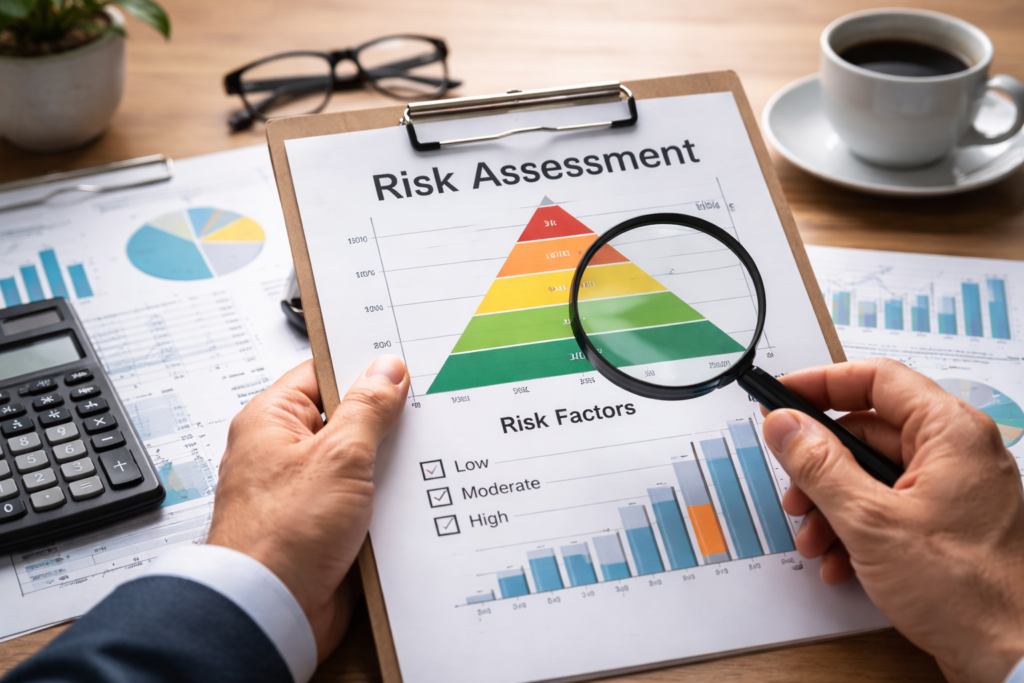
Think of risk assessment as the overall process you use to identify, analyze, and evaluate what could go wrong and how much it matters. It ties the steps together so you reach a decision you can live with.
Risk analysis is the measurement step. Here you estimate likelihood and consequences using qualitative notes or quantitative models. This is where you test sensitivity, run scenarios, or score outcomes.
Risk evaluation is the judgment step. You decide whether a given level of exposure is acceptable for your goals, timeline, and comfort with drawdowns. That choice turns numbers into action.
Example: for bond holdings you identify interest-rate exposure, analyze sensitivity to rate changes, then judge if that exposure fits your plan. Do the math, then make the call.
Mixing these up causes problems: lots of analysis without a decision, or decisions without evidence. Keep each step clear so you know when you are done.

Next, we’ll show why every assessment process must start with context—without it, your numbers and labels mean very little.
Set the Context for Your Investment Risk Assessment Process
Start by defining the ground rules for any investment so your choices match your life.
Note your time horizon, income stability, liquidity needs, and tax situation. These basics narrow the hazards you must consider and show which assets or accounts matter most.
Decide what “loss” means to you. Is it a temporary drawdown or a permanent impairment? That definition keeps the assessment process aligned with real consequences.
Write clear acceptance criteria, for example: “I can tolerate a 20% temporary decline but not a forced sale to cover living expenses.” Use requirements like emergency cash, no leverage, or minimum liquid assets to shape your rules.
Match the level of detail to your portfolio. A three-fund setup needs a simpler management process than a concentrated stock or options book.
Finally, specify which decisions this process must support—buy, hold, sell, position size, or hedging—so your work stays practical and prevents overengineering.
Identify Potential Investment Risks and Threats
First, list what you own and where it sits so you can spot potential threats.
Use a simple asset inventory: holdings, account types, and which assets matter to near-term goals. This makes later risk identification practical.
Write each item in this format: “If X happens, then Y could occur, leading to Z impact.” That keeps your notes consistent and easy to analyze.
Major categories to note: market swings, credit problems, liquidity shortfalls, inflation pressure, and concentration losses. Write one-line examples for each so you can compare them later.
Also identify potential operational and platform threats: account takeover, SIM-swap, or brokerage login compromise that could affect access to funds. Call out user behavior too—panic selling, chasing winners, and overconfidence are real hazards when identifying risks.
Treat this as your first draft of risks identified. You will refine the list after you gather data and run simple tests. The goal is clarity, not fear: map the landscape so you can focus where it matters most.
Gather the Right Data and Information Before You Analyze Anything
Good analysis starts with data you trust, not assumptions you hope are true.
Collect the specific data that maps to the items you listed earlier: historical volatility, drawdowns, correlations, duration, credit ratings, and liquidity measures such as bid‑ask spreads.
Pull information from reliable sources: fund fact sheets, SEC filings, prospectuses, and reputable market data providers. Note the date ranges and any gaps in coverage so your work stays transparent.
Use basic data verification practices. Sanity‑check numbers, confirm ticker changes, and avoid cherry‑picked time frames that warp results.
Write down your assumptions—expected returns, inflation, default rates—because your analysis quality depends on them. Keep this documentation handy for future reviews.
Call out where your portfolio touches external systems like brokerages, banks, and custodians, and how those operations might affect access or settlement.
Address simple compliance items you must track for taxes, account rules, or platform limits. Finally, set a lightweight schedule to repeat these assessments quarterly or annually so your conclusions stay current.
Assess Likelihood and Impact Using a Simple Risk Matrix
Use a simple chart to turn vague worries into clear priorities you can act on.
Build a 3×3 or 5×5 grid in a spreadsheet with likelihood on one axis and impact on the other. Define likelihood in concrete terms, for example “probability of a 10% drawdown within 12 months.” Define impact as a tangible outcome, like a dollar loss, a delayed retirement date, or a forced sale.
Populate the cells so each combination maps to a level from low to high. This risk matrix gives you a comparable level score so different threats can be ranked consistently.
Example: inflation may be high likelihood but medium impact on your portfolio, while a platform lockout is low likelihood but high impact. The grid makes those trade-offs visible.
Avoid false precision. Treat the matrix as a decision aid, not a prophecy. Note uncertainty ranges for volatile assets such as crypto and mark items for follow-up analysis or deeper assessment if needed.
When you have level scores, you can decide whether to use qualitative judgment or run quantitative tests next. For a template and more on matrix design, see this guide: risk assessment matrix.
Choose Qualitative vs Quantitative Risk Assessment Methods
Choose your method by asking whether the outcome will alter the dollars you commit.
For a quick screen, use qualitative tools. Write a short narrative of “what could go wrong” and rate each item high, medium, or low. Use a simple matrix or a small group review like Delphi to capture judgment when data is thin.
When numbers matter, run quantitative tests. Scenario analysis helps you see recession or rate-shock impacts. Decision trees show conditional paths, and Monte Carlo gives a range of probable endings for long goals like retirement. You can also estimate expected loss concepts such as ALE (SLE × ARO) to compare exposures in dollars.
Good analysis makes trade-offs visible. Combine methods: use narratives to catch non‑quantifiable threats, then apply simulations where probabilities change your plan. Watch for model overconfidence—clean inputs and sound judgment must accompany neat outputs.
Finally, pick the approach that points to action. The method you choose should suggest specific moves: rebalance, diversify, hedge, or add cash. Once you refine scores, rank items so you act on what matters most.
Prioritize the Risks You’ve Identified So You Don’t Overreact
Begin with a simple rule: not every worry deserves an immediate fix. Use your matrix scores to rank the items you listed so you act where the harm is real and likely.
Separate high‑impact but unlikely events from those that are both likely and damaging. That keeps small threats from stealing your time and cash. Tie every ranked item back to a concrete goal, like your retirement date or a down payment.
Create a short “top 5” register for your portfolio. For each entry note the cause, the expected effect, and one clear action you will take if the trigger occurs. Select strategies that fit each tier: avoid, mitigate, transfer, or accept.
Make the final step a simple review cadence: monthly quick checks, quarterly rebalancing, and an annual deep dive. That process keeps assessments current and stops you from overreacting to news while still protecting what matters most.
Pick a Risk Management Framework for Your Portfolio
Choose a repeatable system for your portfolio so decisions are calm and consistent.
By “framework” I mean a set of rules you follow for spotting issues, acting, and reviewing results. Use a simple cycle: establish rules, implement them, monitor outcomes, and improve on what you learn.
Borrow what helps from organizational standards like ISO 27001 without adding corporate paperwork. The continual-improvement idea keeps your plan current and practical.
Define roles and cadence: what you will decide, what you automate, and which events trigger a review—job change, rate spikes, or a major market drawdown.
Address compliance in plain terms: account rules, tax-advantaged limits, and strategies you can execute cleanly. That keeps surprises out of tax season and account operations.
Pick a style that fits your time and temperament: a minimalist index framework, a core-satellite model, or a rules-based tactical overlay. Each gives structure and reduces reactive moves.
Once you choose a management framework, document a short mitigation plan that matches your habits and schedule for reviews.
Create a Risk Mitigation Plan You’ll Actually Follow
Turn your list of threats into a short, practical plan that you can actually follow. Write each entry as: the issue, the chosen treatment (accept, transfer, mitigate, or avoid), the specific actions, and a review date.
Include both technical and non-technical control measures. Examples: encryption, MFA, hardware security keys, strong passwords, and clear procedures for withdrawals and beneficiary naming.
Map investment mitigations to categories: diversification, position sizing, rebalancing bands, and cash reserves. Those moves make portfolio exposure tangible and reviewable.
Address home and travel exposures too. If you work remotely, strengthen access controls and train yourself on phishing and account takeover tactics so platform access does not become a financial loss.
Make the plan operational: consolidate accounts where it helps, document who does what, and choose small, repeatable steps you will keep doing. A one-page treatment keeps the process usable in stress.
Remember, risk mitigation reduces exposure but rarely removes it entirely. Track residuals and schedule the next review so your plan stays current.
Measure Residual Risk and Decide What to Accept
Once mitigation steps are in place, the leftover exposure deserves a deliberate check. Define residual risk as the downside that remains after diversification, rebalancing bands, and safety controls.
Re-score your top items after mitigation to see the new level. That shows whether your plan truly reduced exposure or only shifted it.
Weigh further controls against their cost. Extra hedges, lower returns, higher fees, or tax consequences can reduce returns more than they reduce exposure.
Your personal requirements—liquidity needs, timeline, and income stability—set hard boundaries on what you can accept. Use those rules to guide decisions and to meet any compliance limits tied to accounts or tax status.
Some market threats are unavoidable and must be managed, not erased. Set a monitoring routine and clear triggers: allocation drift, a credit downgrade, job loss, or regulatory changes.
Acceptance is an active choice. Document why you accept a given residual risk, note the review date, and treat monitoring as part of ongoing management so future decisions stay calm and consistent.
Conclusion
Wrap up your work with a short, usable plan you will actually follow.
Summarize the loop: a risk assessment to frame what matters, a risk analysis to estimate likelihood and impact, and a risk evaluation to decide action. Use that workflow to guide buys, holds, and position sizing.
Keep documentation, check assumptions, and set review dates. Small, steady practices—one-page mitigation, a basic matrix, and periodic checks—beat perfect forecasts.
Start now: run the first assessment on your current holdings before your next buy. You’ll gain confidence and make consistent, evidence-informed choices without trying to predict every market move.